


(We're) Back in the USSR
What the struggle of dissidents against "totalitarian consumerism" can tell us about reviving civil society.

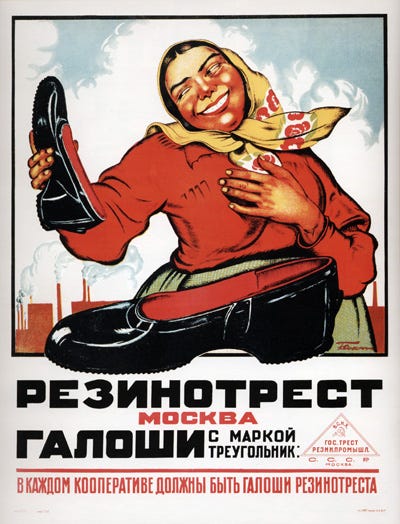
“People withdrew into themselves and stopped taking an interest in public affairs. An era of apathy and widespread demoralization began, an era of gray, everyday totalitarian consumerism. Society was atomized, small islands of resistance were destroyed, and a disappointed and exhausted public pretended not to notice.”
These words were written by the great Czech dissident Vaclav Havel about Communist Central Europe.
They also describe, to an unsettling degree, the United States today.
Havel himself had made such a comparison during the depth of the Cold War, declaring “is not the grayness and emptiness of life in the post-totalitarian system only an inflated caricature of modern life in general? And do we not in fact stand…as a kind of warning to the West, revealing to it its own latent tendencies?”1
These tendencies are no longer latent in America.
Not because our country is Communist or Fascist or Authoritarian, but because it is Corporate. The marriage of the centralized State with the centralized Corporation, the dream of Lenin and many Liberals alike, has been largely accomplished in our time. It has been accomplished through the hollowing out of autonomous civil life, local communities, and individual morality.
And the result is what we have now. Apathy. Atomization. Oligarchs. In a phrase: “Totalitarian Consumerism.”
But we are not the first to have faced this condition. When faced with similar “post-totalitarian” regimes in the Eastern Bloc, Havel and other dissidents recognized that their political task was not of reforming the state, but of rebuilding society.
They realized that, in an era of atomization, establishing civic associations is a political act. That in an era of state-capitalist dominance, creating autonomous economic activity - cooperatives, mutual aid - is revolutionary. Such actions, while not sufficient for liberation unto themselves, provided the civic groundwork necessary for the successful political struggles against the Soviet Empire during the 1980s.
The dissidents’ insights were true then, and they are true now. Build the conditions for an autonomous civil society, and the political results will follow.
Totalitarian Consumerism
“In highly simplified terms, it could be said that the post-totalitarian system has been built on foundations laid by the historical encounter between dictatorship and the consumer society.” - Vaclav Havel
What did Havel mean by “posttotalitarian?” Why might it be a useful framework for understanding our situation today?
The institutional makeup of this state are easy to identify. A large, centralized bureaucracy. No real choice in our rulers. No organized or influential civil society outside the state, except those run by professional apparatchiks. No truly independent public sphere. So far, so familiar.
But here’s where things diverge. “Old” totalitarianism depended on indoctrinating people, on transforming people into ideological warriors.
“Post” totalitarianism didn’t require that. The bureaucracy didn’t need people to “believe” in them. It only needed their consent.
The postttotalitarian state was thus quite comfortable allowing citizens to engage in their “private” pursuits. As long as people focused on their material comfort and retreated from social life, they were neutered as sources of political opposition. On these grounds, Communist state-capitalists offered their citizens a suite of material benefits - stable employment, a decent standard of living, consumer goods, even the occasional luxury - in exchange for their obedience.2 And most people gladly made the exchange.
The result was what Havel called Totalitarian consumerism. It refers to a system in which consumer culture is deeply intertwined with centralized authoritarian control. The centralized state, in league with dominant economic actors, devises policies which allow those actors to monopolize the production and distribution of goods. Privatism and consumption are celebrated as the embodiments of freedom.3 All forms of civil association outside the state or market are allowed to wither away. And while the corporation-state is, in theory, responsible to the wishes of their citizens through votes, in reality the masses have neither the autonomy nor the leverage needed to change the system significantly.
As people grow more cynical and aware of their powerlessness, and as civil society atrophies, people respond by retreating further into private consumption and private life for fulfillment. The social further decays. The corporation-state’s hold over the populace deepens. The cycle becomes self-repeating.
The United States is not the Soviet Union. But I would argue that our society, with its landscape of frustration and cynicism, oligarchs and atomization, has far more in common with the sclerotic soviet empire of the 70s than with, say, Stalinism and Fascism at their “height.”
We are left to our own devices - literally - while feeling constantly monitored. We shake our heads at the non-existence of any viable political “opposition,” while feeling powerless to alter the conditions which oppress us. We are disconnected from the places we live, from our fellow citizens, from the very meaning “citizenship.” We see the prisons and military expand, we sense the decay and decadence behind gerontocracy, we recognize that we are living in the last days of Empire. We seek refuge in the material goods provided by “free market (read: state-subsidized)” cartels.
We are told that this is freedom. We know better.
But what is to be done?
Independent Publics
I believe that what sets today's opposition apart…is the belief that a program for evolution ought to be addressed to an independent public, not to totalitarian power.” - Adam Michnik
Those who sought to overturn “posttotalitarian” Europe made headway only once they lost faith in the old remedies. Specifically, political reform.
During the 1950s and 1960s “revisionist” marxists in Poland, Hungary, and the Czech Republic attempted to work through the established channels of reform. They sought to humanize and democratize the system from within. They failed.
Today we are faced with a similar situation - not just within the government, but within the “opposition” party. Described by Peter Mair as “Cartel Parties,” modern political parties are bureaucratic blobs largely disconnected from civil society, with no clear ideological commitment beyond winning the next election. They are not interested in being reformed. They will not be reformed, at least in the foreseeable future.
Faced with similar conditions in the mid 1970s, however, Eastern Bloc activists responded by devising a new strategy: rather than reforming the State, they would revive the public. The working-class, the intelligentsia, the Church: all these groups had presented opposition to the Soviets in the past, and still possessed traces of independent civic existence in society. Expanding their independence outside the State, activists like Adam Michnik argued, would provide the foundation for broader political success in the future.
The dissidents were divided, of course, on how to do this. Some sought to directly organize political opposition to the State: by establishing an independent public sphere outside the corporate-state’s purview, people could better develop and demand alternative political frameworks.
Others followed Vaclav Benda’s idea of a “parallel polis:” rather than seek to transform the state, activists would make society autonomous from it. By assuming the economic, cultural, and political functions of the corporate-state, citizens could increase their leverage over it.
Finally, Vaclav Havel argued in “the power of the powerless” that citizens needed to build up the values of trust, cooperation, and solidarity before they acted politically. Individuals could not act socially, and by extension politically, as long as they were atomized and a-social. Restoring their ties to communities, even in seemingly “a-political” venues like rock concerts, could help provide the ground for more conscious political movements to come. As Havel wrote, “ “[O]ppositions,’ emerge, like the proverbial one- tenth of the iceberg visible above the water…from the independent life of society.”
Who was correct?
All of them.
Revolutions
“People had had enough of being mere components in a deliberately atomized society: they wanted to be citizens, individual men and women with dignity and responsibility, with rights but also with duties, freely associating in civil society.” - Timothy Garton Ash
The defeat of Communism in Eastern Europe was not the sole product of Eastern/Central European dissidents. Gorbachev’s refusal to militarily intervene in the region during the unrest of the 1980s was perhaps the most important factor in that unrest’s success.
But this begs the question: why did Eastern Europe erupted in revolt in the first place? And much of that had to do with the writing and actions of the dissidents I’ve discussed.
Take the example of Charter 77, an Czech underground document meant to secure relatively legalistic human rights. It was signed largely by artists and intellectuals with little popular backing. Nonetheless, it created a network of and rationale for independent intellectual life in the midst of the Communist desert, an environment where in the words of one participant ,“people could learn again to live in the public sphere, to examine the state of common affairs and at the same time not to let slip the moment when it was necessary to act; when it was necessary to leave the parallel polis and begin to make—with everything this implied—real, that is “political” politics.”
That moment came soon. Shortly after Charter 77 was formed, the Worker’s Self-Defense Committee, or KOR, was formed in Poland. Two things made KOR unique: first, it was the first grassroots political movement to unite intellectuals and workers within a single organization anywhere in the eastern bloc. Second, their goals were explicitly NOT state-oriented, but focused instead on providing concrete assistance - financial, legal, medical - to workers suffering from government repression. These tendencies, together with a “parallel polis” of associated independent universities, underground newspapers, and mutual aid networks, helped KOR ground itself in and rebuild civil society across Poland.
And after all this spadework: results. In the early 1980s, veterans of KOR raised their ambitions to demand independent trade unions in Poland, thus uniting the causes of political democracy, civil society autonomy, and working-class power together. The name of this independent trade union: Solidarity.
Similarly, in 1989 veterans of Charter 77 formed Civic Forum as a base for pressing civic demands upon the State. The underground civil society that had been nurtured through the writings of Havel and Michnik, was now politicized and in the open. And their demands of popular sovereignty would be achieved with a rapidity that astonished the world.4
Back in the USSA
“The attempt at political reform was not the cause of society’s reawakening, but rather the final outcome of that reawakening.” - Vaclav Havel
Which of these strategies are most relevant today in the US?
This deserves its own separate post, of course. Mapping out the opportunities and constraints available to contemporary ‘civic-revivalists’ is going to be a key part of my future writing here. But I’ll put a few thoughts down now.
Unlike the Eastern Bloc, the US has plenty of politically-oriented civil society groups. Most of them, however, are dominated by a narrow strata of professional workers (what in the Bloc was called the “intelligentsia.”) Others, like Theda Skocpol and Daniel Shlozman, have written on why this is: the point is that America’s “counter-publics” are broad, but shallow and unrepresentative. This holds true for political parties as well as for nonprofits.
This leads to the relevance of the “parallel polis” strategy. As I’ve written about, the dissolution of civil cociety groups in this country is largely because their material functions have been co-opted by the centralized state and corporations. Only through a strategy of “civic materialism” - be re-embedding economic life within community and local life - can we rebuild civil society and its virtues. Thankfully, there are many groups and individuals currently invested this strategy, and I consider it my personal mission to aid them however I can.
Finally, Havel’s notion of “antipolitical” public sphere seems promising, but this presupposes a commitment to joining civil society groups in the first place. The Soviet Union, for all its atomization, was nonetheless rich in state-sponsored social groups - from hiking clubs to labor unions to bowling societies (really!). While far from acting as independent civil society as Tocqueville might have preferred, these groupings nonetheless encouraged a certain kind of social-mindedness among their participants. Even the rough homogeneity and equality within the Eastern Bloc promoted a sense of solidarity: as Timothy Garton Ash has wrote, “[I]n large measures communism created the social unity which contributed decisively to the end of communism.” The United States, it need not be said, lacks this kind of social unity.
But the situation is not hopeless. Few in the early 1980s could have imagined that the Soviet Union’s reign over Central and Eastern Europe could have fallen, much less so rapidly and non-violently. I believe, with
, that we are “at the start of a generational moment of civic renewal.”But if we are to seize this moment, we need to go beyond the banalities of politics-as-usual. We need to name what we are confronted with, learn from those who have confronted it in the past, and act accordingly. This means, as I’ve written here and elsewhere, engaging in the “pre-political” work of reviving civil society, - particularly through tailored economic strategies.
Accomplishing this will be difficult. But there’s nothing else I’d rather be working towards. I hope you’ll join me.
As he wrote elsewhere, “To think that, with respect to the relation of western Europe to the totalitarian systems, no error could be greater than the one looming largest: that of a failure to understand the totalitarian systems for what they ultimately are: a convex mirror of all modern civilization and a harsh call for a global recasting of how that civilization understands itself.”
Havel on state consumerism: “In the interest of the smooth management of society, then, society’s attention is deliberately diverted from itself, that is, from social concerns. By fixing a person’s whole attention on his mere consumer interests, it is hoped to render him incapable of realizing the increasing extent to which he has been spiritually, politically, and morally violated. Reducing him to a simple vessel for the ideals of a primitive consumer society intended to turn him into pliable material for complex manipulation.The danger that he might conceive a longing to fulfill some of the immense and unpredictable potential he has as a human being is to be nipped in the bud by imprisoning him within the wretched range of parts he can play as a consumer, subject to the limitations of a centrally directed market.”
As one veteran stated after the fall of Communism, “When I look at the victories of Solidarity and Charter 77, I see in them an astonishing fulfillment of the prophecies and knowledge contained in Havel’s essay [The Power of the Powerless].”
@Jonathan Parkes Allen
Would love your thoughts @Russell Arben Fox @Celeste Marcus @Connective Tissue @Michael Shuman @Nils Gilman @Elias Crim @Pete Davis @Douglas Rushkoff @Sam Adler-Bell @Timothy Snyder @Addison Del Mastro @Matt Stoller @damonlinker