
Shine, Perishing Republic
An Independence Day Musing

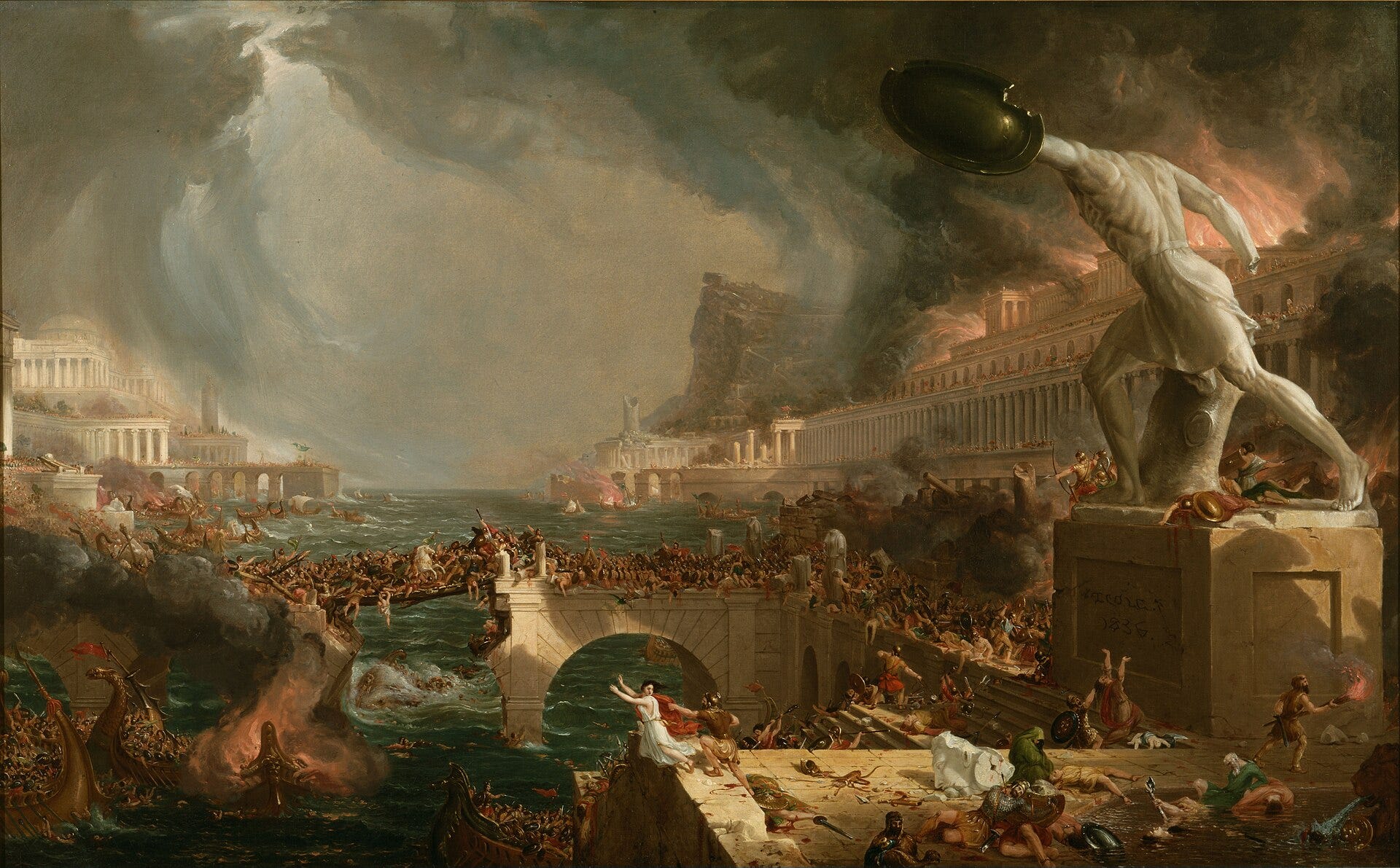
Two weekends ago I was invited by Sublation Media to speak on whether America was a republic or not. Here’s what I said.
While this America settles in the mould of its vulgarity, heavily thickening to empire,
And protest, only a bubble in the molten mass, pops and sighs out, and the mass hardens,
I sadly smiling remember that the flower fades to make fruit, the fruit rots to make earth.
Out of the mother; and through the spring exultances, ripeness and decadence; and home to the mother.
You making haste on decay: not blameworthy; life is good, be it stubbornly long or suddenly
A mortal splendor: meteors are not needed less than mountains: shine, perishing republic [.]
—Robinson Jeffers, ‘Shine, Perishing Republic’
Jeffers wrote this in 1925. He was easily one of the most idiosyncratic and misanthropic writers America has produced — he called his philosophy “inhumanism” — but the poem nonetheless captures a recognizably republican pathos: a vital young civilization falling into decadence, corruption, and decay, the way Thomas Cole staged it across his Course of Empire paintings a century earlier.
It’s a long-standing fear — that America is no longer a republic — voiced in the 1840s, the 1870s, the 1920s, and today.
I’m not here to say we are a republic. But I do think we’re beginning to begin becoming one — rethinking the political and economic frameworks we inherited from the twentieth century in ways that might restore a measure of republicanism to this country.
I say this because while republicanism as a fact might be more or less dead today, republicanism as an ideal died — or seemed to — long before. During the postwar years, and arguably well before, republicanism as a living ideology was all but read out of political and economic theory. It was only on these grounds that Isaiah Berlin could define liberty in purely positive and negative terms — the notion that liberty might also mean non-domination or popular sovereignty was simply off the table for him and most of his contemporaries. Liberalism reigned in political philosophy, just as “industrial society,” and later “neoliberalism,” reigned in economics. History seemed to have ended well before 1989.
But today, in our “postliberal” moment, something is shifting. Elements of republicanism are being taken up by scattered, uncoordinated groups — but at a pace and vigor we haven’t seen in decades. I want to explore some of these experiments, how they came about, and what more is needed to revive the best of republicanism today.
What we mean by republicanism
To borrow from Michael Freeden, we can think of a political ideology as built from a few core propositions, a broader cluster of contested strategies (which mark out divisions within that ideology), and a still broader array of terms and tactics it shares with rival ideologies.
The core concepts of republicanism are non-domination and popular sovereignty. The conditions for realizing these are some mixture of civic virtue, autonomy, and political participation. Where it gets tricky — and historical — is in how we operationalize those conditions: through the free market or through cooperatives, through localism or through empire, or some combination of the two.
The early history of republicanism in this country can be told fairly quickly. Classical republicanism depended on the economic autonomy of the few — a autonomy secured by their being freed from material need, thanks to the manual labor and slavery of others. To be a wage laborer and a good republican was, in the classical sense, a contradiction in terms.
The great breach in American republicanism came in the nineteenth century. I’ll focus on its economic dimension: whether republican virtue could be secured through the market or through cooperation. The market promised both greater dependence on many masters and freedom from dependence on any single one.
That idea was challenged forcefully by labor republicans after the 1870s. To depend on any master, they argued, was to be dominated by them. Only through cooperation and the restoring of economic autonomy could workers manfully assert their collective independence — a position the Knights of Labor and the Populist Party pressed hardest.
Elements of this tradition persisted. In my book, The Menace of Prosperity, I trace how generations of New Yorkers — from Henry George to Jane Jacobs — carried republican economic ideals forward, turning them into both fiscal and economic critiques of corporate capitalism.
A few examples:
1870s — Speculators drove roughly one in five New Yorkers into economic precarity; the response came from the Knights of Labor and a movement for municipal ownership.
1930s — Financialized real estate met its counter in public housing and cooperative housing movements.
1970s — As the top 1% of firms displaced manufacturing but placed enormous new burdens on the city — demanding infrastructure and debt to service them while remaining far more mobile than the manufacturers they replaced — the city’s fiscal capacity buckled.
Why did these alternatives fail? Partly organized opposition. Partly the depoliticization of fiscal policy itself. But also, frankly, because most of the organized left — and left-liberals more broadly — were never especially enthusiastic about these approaches in the first place.
Keynesians were interested in growing the conventional economy, not restructuring it.
Unions were mostly interested in extracting more benefits from the existing economy.
Social democrats were mostly interested in redistribution after economic damage had already been done.
Marxists, while focused on changing ownership, still largely assumed the economic future lay in large-scale Fordist production, and had little interest in resisting that model along republican lines.
This was especially apparent after the 1970s fiscal crisis. Nearly all the political energy went into bailing out the city; almost none went into developing economic alternatives. In that sense, the fiscal crisis was a missed opportunity.
Where we are now
So where does republicanism in America stand today?
The hope of a single-producer economy has essentially collapsed. Small business’s share of the economy is shrinking even where its raw count looks stable — small business’s share of GDP fell from 57% in 1957 to 43.5% in 2023 (SBA data). A century of IRS data shows the top 0.1% of US companies by assets going from holding 47% of all corporate assets in the 1930s to holding 88% today; the top 1% went from 70% to 90% over the same period. Self-employment, meanwhile, has been flat for thirty years despite all the “gig economy” talk: 12.1% in 1994, 10.1% in 2015, about 10.3% (16.8 million people) today (BLS).
But there are some signs of hope on the economic front. The worker-owned sector has reportedly tripled over the past decade. Community land trusts have grown steadily — 162 in 2006, 225 in 2018, 289 today. CDFIs numbered 1,432 Treasury-certified institutions as of winter 2025, managing over $222 billion across all fifty states (Opportunity Finance Network / CDFI Fund). Credit unions now claim 144.7 million members and $2.4 trillion in assets as of late 2025 (NCUA) — genuinely massive, comparable in scale to a major bank sector.
Perhaps most importantly, we are seeing the economy being politicized in ways we haven’t seen for some time. At least 64 US cities and counties have run a participatory-budgeting process, along with 258 school districts and wards and over 260 schools. We’re also seeing new frameworks emerge — “solidarity economy,” “wellbeing economy” — trying to name the alternative.
So far, though, the organized left hasn’t effectively leveraged any of this. There are exceptions — some DSA chapters run mutual-aid or solidarity-economy working groups. But for the most part, socialists haven’t made cooperatives or other mutualist enterprises central to their strategy, or have failed to use them at all.
What I’d recommend
The electoral and union-minded left should ask directly: what kind of economic organizations, benefiting what constituencies, would help us build the leverage we need to win elections and expand our power? Republicans knew that true liberty is achieved through economic decentralization and local autonomy, but it is also through these means that the left can reach the constituencies and generate the civic capacity needed for them to advance.
But beyond that, I’d encourage the left to look past republican economics to consider republican virtues also as a source of renewal. It may be true, for the more materially minded among us, that our problems are at bottom economic. But addressing an economic problem has never been simply a matter of building rival economic power. It has also required building a politics — one capable of turning economic alternatives into public common sense. And politics depends on a moral infrastructure of wisdom, empathy, courage, and solidarity that the left ignores at its peril.
But there’s a final element of the republican tradition we should recall: the notion that civilizational decay is a common and recurrent fate, not an exceptional. If the growth of tyranny and the loss of civic virtue in our time is a cause for lament, neither should it be absolutely paralyzing. America has been through this before. What matters is whether we learn from this past and defeat the forces of political tyranny and economic centralization that the American Revolution, at its best, stood for.
Happy fourth.
Thank you for sharing this. I certainly have a great deal of unity with the general thrust of your arguments and in the direction that they are headed. I also think that localities must link up more broadly with other local projects through regional and national coordination. That local projects need greater degrees of autonomy but in fact cannot survive in isolation for very long. I think the municipalist idea of confederation, particularly as it is interpretated by Cooperation Jackson in the Build and Fight formula, does hold strategic value and relevance. I'd be interested in hearing more from you about how the local autonomy expands into a national republican framework. Thanks again.
I don't know if we can realistically replace our current economy with one based on small independent producers and local autonomy. Such an economy would be more egalitarian but less productive and less efficient, and would slow or maybe even reverse economic growth to a degree that would have dangerous ramifications for both internal stability and external relations. But we can redirect much more of the wealth generated by our current economy in ways that promote civic and human virtue:
https://logosandliberty.substack.com/p/republicanism-and-the-eudaimonic